
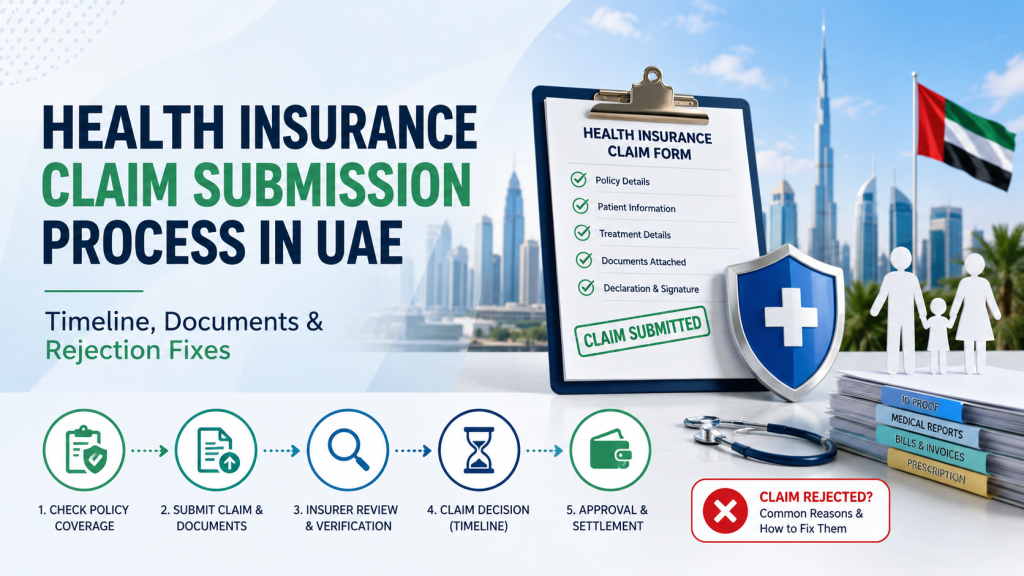
Filing a health insurance claim in the UAE should be straightforward — but for many expats, it becomes a frustrating experience filled with delays, confusing paperwork, and unexpected rejections. Understanding the health insurance claim submission process from start to finish can mean the difference between getting your money back in two weeks or waiting months without resolution.
Whether you are submitting a claim for a doctor’s visit, a hospital stay, or a specialist treatment, this guide walks you through every step of the process. We cover timelines, required documents, how to handle rejections, and insider tips to speed up your reimbursement.
Table of Contents
- Two Types of Claims in the UAE
- Direct Billing vs Reimbursement — Key Differences
- Step-by-Step Claim Submission Process
- Required Documents for Different Claim Types
- Claim Processing Timeline by Insurer
- Top 5 Reasons Claims Get Rejected
- How to Fix a Rejected Claim
- Tips to Speed Up Your Claim
- Case Study: Successful Claim After Initial Rejection
- Frequently Asked Questions
Two Types of Claims in the UAE
1. Direct Billing (Cashless)
The most convenient method. You visit a network hospital, show your insurance card, and the hospital bills the insurer directly. You only pay the co-payment amount (typically 20%). No claim submission is needed from your end.
2. Reimbursement Claims
When you visit a non-network provider, pay upfront, and then submit a claim to your insurer for reimbursement. This is more common when:
- You visit a doctor or hospital outside your network
- You receive emergency treatment abroad
- The provider’s billing system is temporarily unavailable
- You are referred to a specialist not covered by direct billing
Direct Billing vs Reimbursement — Key Differences
| Feature | Direct Billing | Reimbursement |
|---|---|---|
| Out-of-Pocket Payment | Co-pay only (20%) | Full amount upfront |
| Claim Submission | Handled by hospital | Submitted by you |
| Processing Time | Instant (at point of care) | 7–45 business days |
| Documentation Needed | Insurance card + Emirates ID | Receipts, prescriptions, claim form |
| Reimbursement Rate | Not applicable | 80% of approved amount (varies) |
| Pre-Authorization | Sometimes required | Usually not applicable |
Step-by-Step Claim Submission Process
Step 1: Collect All Documentation at Point of Service
Before leaving the hospital or clinic, ensure you receive all of the following:
- Itemized invoice/receipt (not just the payment slip)
- Doctor’s prescription or referral letter
- Diagnostic report (lab results, imaging)
- Discharge summary (for inpatient claims)
- Proof of payment (credit card receipt or bank transfer confirmation)
Step 2: Download and Complete the Claim Form
Every insurer has a standard claim form — download it from their website or app. Fill in all fields completely. Incomplete forms are the number one cause of processing delays.
Step 3: Organize and Submit Documents
Submit the claim form along with all supporting documents through one of these channels:
- Mobile app: Upload photos of documents (fastest method)
- Email: Send scanned documents to the insurer’s claims email
- Online portal: Upload through the insurer’s member portal
- Physical submission: Visit the insurer’s office (least recommended)
Step 4: Track Your Claim
Most insurers provide a claim reference number. Use this to track the status through their app or portal. Follow up if you do not see an update within 10 business days.
Step 5: Receive Reimbursement
Approved claims are typically paid through bank transfer to your registered account. Some insurers offer cheque payment, though this is becoming less common.
Required Documents for Different Claim Types
| Claim Type | Required Documents |
|---|---|
| Outpatient (Doctor Visit) | Claim form, receipt, prescription, referral letter (if specialist) |
| Inpatient (Hospital Stay) | Claim form, discharge summary, itemized bill, payment proof, medical report |
| Pharmacy | Claim form, pharmacy receipt, original prescription |
| Maternity | Claim form, prenatal/postnatal reports, hospital bill, delivery report |
| Emergency (Overseas) | Claim form, medical report, receipts, passport stamps showing travel dates |
| Dental | Claim form, dental report, X-rays, itemized receipt |
Claim Processing Timeline by Insurer
| Insurer | Standard Processing | Complex Claims | Payment Method |
|---|---|---|---|
| Cigna | 5–10 business days | 15–25 business days | Bank transfer |
| AXA | 10–15 business days | 20–45 business days | Bank transfer |
| Oman Insurance | 7–12 business days | 20–30 business days | Bank transfer/cheque |
| Daman | 10–15 business days | 25–40 business days | Bank transfer |
| ADNIC | 10–14 business days | 20–35 business days | Bank transfer |
Note: Complex claims include maternity, surgical procedures, and claims requiring additional medical review.
Top 5 Reasons Claims Get Rejected
1. Non-Covered Service
The treatment is excluded under your policy. Common exclusions: cosmetic procedures, experimental treatments, pre-existing conditions during the waiting period, and alternative medicine.
2. Incomplete Documentation
Missing receipts, unsigned claim forms, or unclear medical reports. This is the most fixable reason — simply resubmit with complete documents.
3. Out-of-Network Provider
Visiting a provider not in your plan’s network. Some plans reimburse out-of-network claims at a lower rate (50–60%), while others reject them entirely.
4. Pre-Authorization Not Obtained
Certain procedures require advance approval from the insurer. If you skip this step, the claim may be rejected even if the treatment is normally covered.
5. Claim Filed After Deadline
Most insurers require claims within 60–90 days of treatment. Late submissions are automatically rejected with limited appeal options.
How to Fix a Rejected Claim
Step 1: Read the Rejection Letter Carefully
The insurer must provide a reason for rejection. Understanding the specific reason determines your next action.
Step 2: Gather Additional Evidence
If rejected for insufficient documentation, collect the missing items. If rejected for medical necessity, ask your doctor to provide a detailed medical justification letter.
Step 3: Submit a Formal Appeal
Write a clear appeal letter referencing your policy terms and attaching all supporting documents. Most insurers allow one appeal within 30 days of rejection.
Step 4: Escalate If Necessary
If the appeal is denied, you can file a complaint with:
- DHA (Dubai): Through the DHA complaints portal or call 800-342
- DOH (Abu Dhabi): Through the DOH website or call 800-555
- Insurance Authority: For disputes with the insurer’s decision
Tips to Speed Up Your Claim
- Use the insurer’s mobile app for submissions — it is typically the fastest channel
- Submit claims within 7 days of treatment, not at the deadline
- Always get itemized receipts (not just total amounts)
- Keep a copy of everything you submit
- Register your bank details in your insurer profile before submitting claims
- Follow up proactively on day 10 if you have not received an update
Case Study: Successful Claim After Initial Rejection
Emma, a British expat in Dubai, had knee surgery costing AED 35,000. She submitted a reimbursement claim to her insurer (Cigna Enhanced plan). The claim was initially rejected because the hospital’s invoice did not include the procedure code and the pre-authorization reference was missing from the claim form.
What she did:
- Contacted the hospital to get a corrected itemized invoice with procedure codes
- Called Cigna to retrieve the pre-authorization reference number
- Submitted an appeal with the corrected documents within 15 days
- Received approval within 8 business days
- Got AED 28,000 reimbursed (80% of the approved amount) via bank transfer
Total time: 5 weeks from initial submission to payment. If she had submitted correctly the first time, it would have taken approximately 2 weeks.
Frequently Asked Questions
How long does health insurance claim processing take in UAE?
Standard claims typically take 5–15 business days depending on the insurer. Complex claims involving surgery, maternity, or pre-existing conditions can take 20–45 business days. Cigna tends to be the fastest at 5–10 days while AXA and Daman may take 10–15 days for standard claims. App-based submissions are generally processed faster than email or physical submissions.
What documents do I need to submit a health insurance claim in UAE?
You need a completed claim form, itemized receipt with the provider’s stamp, original prescription or referral letter, diagnostic reports, and proof of payment. For inpatient claims, also include the discharge summary and detailed medical report. Keep originals and submit clear scans or photographs through the insurer’s preferred channel.
Why was my health insurance claim rejected in UAE?
The most common reasons are non-covered services, incomplete documentation, visiting out-of-network providers, missing pre-authorization, and filing past the deadline. Check your rejection letter for the specific reason, then either resubmit with complete documents or file a formal appeal within 30 days of the rejection notice.
Can I appeal a rejected health insurance claim in UAE?
Yes. All insurers in the UAE must provide an appeal process. Submit a formal appeal letter with additional supporting documents within 30 days of rejection. If the appeal is denied, you can escalate to the DHA (Dubai), DOH (Abu Dhabi), or the UAE Insurance Authority for independent review of your case.
What is the deadline for submitting a health insurance claim in UAE?
Most insurers require claims to be submitted within 60 to 90 days from the date of treatment. Some insurers allow up to 120 days for overseas emergency claims. Late submissions are typically automatically rejected. To avoid deadline issues, submit your claim within the first week after receiving treatment.
About the Author
Sarah Mitchell is a UAE-based insurance process specialist and consumer advocate with over 12 years of experience helping expats navigate complex claim procedures. She has assisted in resolving over 500 claim disputes and regularly publishes practical guides on healthcare administration in the Gulf region.
Related Articles You May Find Helpful
- Top health insurance companies in UAE
- Switching health insurance providers in UAE
- Health insurance for chronic conditions in UAE
- Mandatory health insurance rules for expats in UAE
- Health insurance optimization guide for UAE expats
Useful External Resources
Disclaimer: This article is for informational purposes only. Claim processes, timelines, and documentation requirements vary by insurer. Always refer to your specific policy document and insurer guidelines. Last updated February 2026.
Conclusion
The health insurance claim process in the UAE does not have to be complicated. By understanding the difference between direct billing and reimbursement, keeping thorough documentation, and submitting claims promptly, you can maximize your reimbursement and minimize delays. If a claim is rejected, you have clear appeal options that often result in successful resolution.
Take Action
- Download your insurer’s claim form and familiarize yourself with it before you need it
- Save your insurer’s claims email and app login for quick access
- Share this guide with colleagues who might benefit
- Explore our guide on switching health insurance providers for better claim experiences